

Android 14 では、デベロッパー向けに優れた機能と API が導入されました。以下では、アプリの機能を確認し、関連する API を試すことができます。
追加、変更、削除された API の詳細な一覧については、API 差分レポートをご覧ください。追加された API について詳しくは、Android API リファレンスをご覧ください。Android 14 の場合は、API レベル 34 で追加された API をご確認ください。プラットフォームの変更がアプリに影響する可能性がある領域については、Android 14 の動作変更(Android 14 をターゲットとするアプリの場合とすべてのアプリの場合)をご確認ください。
国際化
アプリ別の言語設定
Android 14 では、Android 13(API レベル 33)で導入されたアプリ別の言語機能が拡張され、以下の機能が追加されています。
アプリの
localeConfigの自動生成: Android Studio Giraffe Canary 7 および AGP 8.1.0-alpha07 以降では、アプリで自動的にアプリ別の言語設定をサポートするよう設定できます。Android Gradle プラグインは、プロジェクト リソースに基づいてLocaleConfigファイルを生成し、そのファイルへの参照を最終マニフェスト ファイルに追加します。そのため、手動でファイルを作成または更新する必要はありません。AGP は、アプリ モジュールのresフォルダ内のリソースと、ライブラリ モジュールの依存関係を使用して、LocaleConfigファイルに含めるロケールを決定します。アプリの
localeConfigの動的アップデート:LocaleManagerのsetOverrideLocaleConfig()メソッドとgetOverrideLocaleConfig()メソッドを使用して、デバイスのシステム設定にある、アプリでサポートされる言語のリストを動的にアップデートします。この柔軟性を利用して、サポートされる言語のリストを地域ごとにカスタマイズしたり、A/B テストを実施したりできます。また、アプリがローカライズのためにサーバー側の push を使用する場合は、更新されたロケールのリストを提供できます。インプット メソッド エディタ(IME)によるアプリの言語の確認: IME は
getApplicationLocales()メソッドを使用して現在のアプリの言語を確認し、IME 言語をその言語と一致させます。
Grammatical Inflection API
30 億人もの人々が、性別で文法が変わる言語を話します。こうした言語では、話す相手、または言及する人や物の性別に応じて、各文法範疇(名詞、動詞、形容詞、前置詞など)の語形が変化します。伝統的に、性別で文法が変わる多くの言語では、男性形をデフォルトまたは汎用の性別として使用しています。
女性を男性形で呼ぶなど、ユーザーに対して不適切な文法的性を使用すると、そのユーザーのパフォーマンスと態度に悪影響を及ぼす可能性があります。一方、ユーザーの文法的性を適切に反映した言語を使用して UI を作成すると、ユーザー エンゲージメントが向上し、より自然でパーソナライズされたユーザー エクスペリエンスを提供できます。
To help you build a user-centric UI for gendered languages, Android 14 introduces the Grammatical Inflection API, which lets you add support for grammatical gender without refactoring your app.
地域の設定
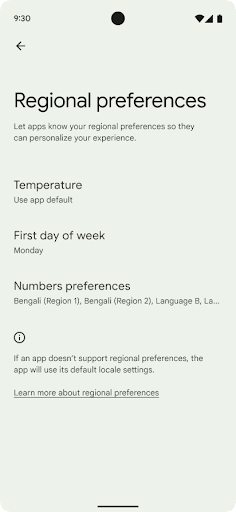
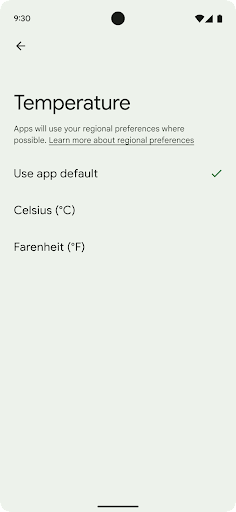
用户可通过地区偏好设置对温度单位、一周的第一天和编号系统进行个性化设置。居住在美国的欧洲用户可能更希望使用摄氏度,而不是华氏度,并且希望应用将星期一视为一周的开始,而不是像美国那样默认从星期日开始。
新 Android 设置菜单包含这些偏好设置,使用户能够在一个位置集中发现这些应用更改偏好设置。这些偏好设置在备份和恢复设备后也会保持不变。多个 API 和 intent(例如 getTemperatureUnit 和 getFirstDayOfWeek)会为您的应用授予读取权限来访问用户偏好设置,因此您的应用可以调整其显示信息的方式。您还可以在 ACTION_LOCALE_CHANGED 上注册 BroadcastReceiver,以便在地区偏好设置发生更改时处理语言区域配置更改。
如需找到这些设置,请打开“设置”应用,然后依次前往系统 > 语言和输入法 > 地区偏好设置。
ユーザー補助
非線形フォント スケーリングを 200% にする
Starting in Android 14, the system supports font scaling up to 200%, providing users with additional accessibility options.
To prevent large text elements on screen from scaling too large, the system applies a nonlinear scaling curve. This scaling strategy means that large text doesn't scale at the same rate as smaller text. Nonlinear font scaling helps preserve the proportional hierarchy between elements of different sizes while mitigating issues with linear text scaling at high degrees (such as text being cut off or text that becomes harder to read due to an extremely large display sizes).
Test your app with nonlinear font scaling
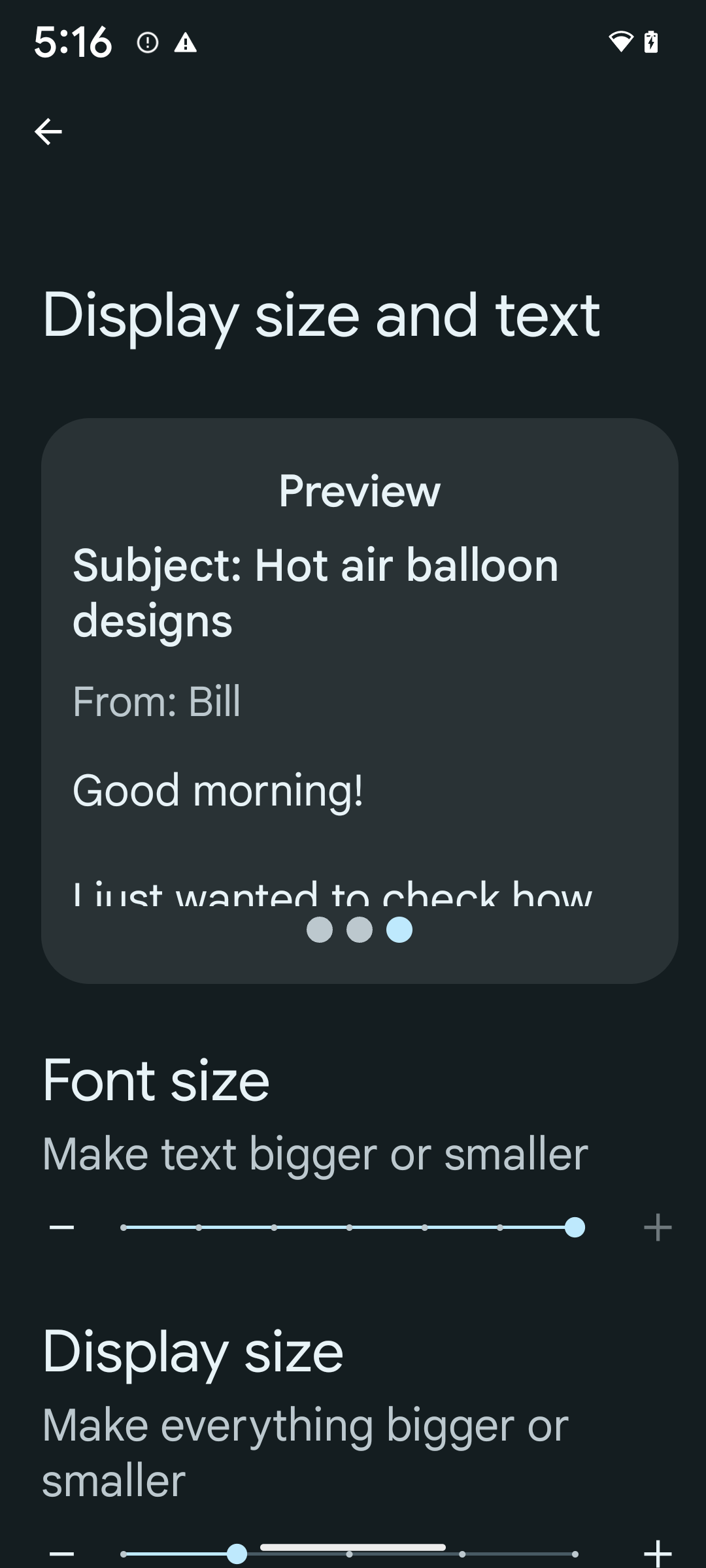
If you already use scaled pixels (sp) units to define text sizing, then these additional options and scaling improvements are applied automatically to the text in your app. However, you should still perform UI testing with the maximum font size enabled (200%) to ensure that your app applies the font sizes correctly and can accommodate larger font sizes without impacting usability.
To enable 200% font size, follow these steps:
- Open the Settings app and navigate to Accessibility > Display size and text.
- For the Font size option, tap the plus (+) icon until the maximum font size setting is enabled, as shown in the image that accompanies this section.
Use scaled pixel (sp) units for text-sizes
Remember to always specify text sizes in sp units. When your app uses sp units, Android can apply the user's preferred text size and scale it appropriately.
Don't use sp units for padding or define view heights assuming implicit padding: with nonlinear font scaling sp dimensions might not be proportional, so 4sp + 20sp might not equal 24sp.
Convert scaled pixel (sp) units
Use TypedValue.applyDimension() to convert from sp units
to pixels, and use TypedValue.deriveDimension() to
convert pixels to sp. These methods apply the appropriate nonlinear scaling
curve automatically.
Avoid hardcoding equations using
Configuration.fontScale or
DisplayMetrics.scaledDensity. Because font scaling is
nonlinear, the scaledDensity field is no longer accurate. The fontScale
field should be used for informational purposes only because fonts are no longer
scaled with a single scalar value.
Use sp units for lineHeight
Always define android:lineHeight using sp units instead
of dp, so the line height scales along with your text. Otherwise, if your text
is sp but your lineHeight is in dp or px, it doesn't scale and looks cramped.
TextView automatically corrects the lineHeight so that your intended
proportions are preserved, but only if both textSize and lineHeight are
defined in sp units.
カメラとメディア
画像のウルトラ HDR
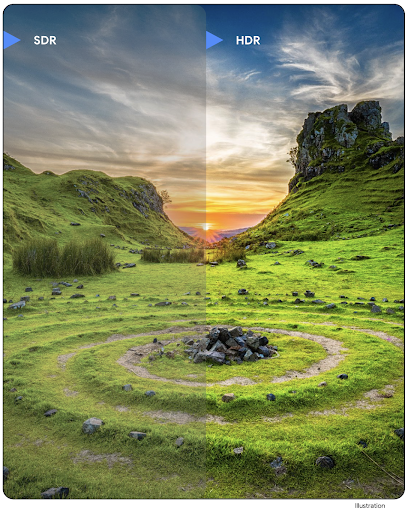
Android 14 では、ハイ ダイナミック レンジ(HDR)画像のサポートが追加されました。HDR 画像では、写真の撮影時にセンサーからの情報の多くを保持できるため、鮮やかな色と高いコントラストを実現できます。Android では ウルトラ HDR 形式が使用されます。これは JPEG 画像と完全に下位互換性があるため、アプリは HDR 画像とシームレスに相互運用し、必要に応じて標準ダイナミック レンジ(SDR)で表示できます。
これらの画像を HDR で UI にレンダリングすることは、アプリがアクティビティ ウィンドウで HDR UI の使用をオプトインした場合、マニフェスト エントリを介して、または実行時に Window.setColorMode() を呼び出すことで、フレームワークによって自動的に実行されます。サポートされているデバイスでは、圧縮されたウルトラ HDR 静止画をキャプチャすることもできます。センサーから回復できる色が増えると、ポスト処理での編集がより柔軟になります。ウルトラ HDR 画像に関連付けられた Gainmap を使用して、OpenGL または Vulkan でレンダリングできます。
カメラ拡張機能のズーム、フォーカス、ポストビューなど
Android 14 では、カメラ拡張機能がアップグレードされ、改善されています。これにより、アプリはより長い処理時間を処理できるため、サポートされているデバイスで暗い場所での撮影などのコンピューティング負荷の高いアルゴリズムを使用して画像を改善できます。これらの機能により、カメラの拡張機能を使用する際のユーザー エクスペリエンスがさらに堅牢になります。主な改善点は次のとおりです。
- 動的な静止画撮影処理レイテンシの推定では、現在のシーンと環境条件に基づいて、はるかに正確な静止画撮影レイテンシの推定値が得られます。
CameraExtensionSession.getRealtimeStillCaptureLatency()を呼び出して、2 つのレイテンシ推定メソッドを持つStillCaptureLatencyオブジェクトを取得します。getCaptureLatency()メソッドは、onCaptureStartedとonCaptureProcessStarted()間の推定レイテンシを返します。getProcessingLatency()メソッドは、onCaptureProcessStarted()と利用可能な最終的な処理済みフレーム間の推定レイテンシを返します。 - キャプチャの進行状況コールバックをサポートし、アプリが長時間実行の静止画キャプチャ処理オペレーションの現在の進行状況を表示できるようにします。この機能が
CameraExtensionCharacteristics.isCaptureProcessProgressAvailableで使用可能かどうかを確認します。使用可能であれば、onCaptureProcessProgressed()コールバックを実装します。このコールバックには、進行状況(0 ~ 100)がパラメータとして渡されます。 拡張機能固有のメタデータ(
EXTENSION_BOKEHによる背景のぼかしの量など、拡張機能の効果の量を調整するためのCaptureRequest.EXTENSION_STRENGTHなど)。カメラ拡張機能の静止画撮影用ポストビュー機能。最終的な画像よりも処理が少ない画像をより迅速に提供します。拡張機能で処理レイテンシが増加している場合は、UX を改善するためにポストビュー画像をプレースホルダとして提供し、後で最終的な画像に切り替えることができます。この機能が使用可能かどうかは、
CameraExtensionCharacteristics.isPostviewAvailableで確認できます。次に、OutputConfigurationをExtensionSessionConfiguration.setPostviewOutputConfigurationに渡すことができます。SurfaceViewのサポートにより、より最適化され、電力効率の高いプレビュー レンダリング パスが可能になりました。拡張機能の使用中にタップしてフォーカスとズームをサポート。
センサー内ズーム
When REQUEST_AVAILABLE_CAPABILITIES_STREAM_USE_CASE in
CameraCharacteristics contains
SCALER_AVAILABLE_STREAM_USE_CASES_CROPPED_RAW, your app
can use advanced sensor capabilities to give a cropped RAW stream the same
pixels as the full field of view by using a CaptureRequest
with a RAW target that has stream use case set to
CameraMetadata.SCALER_AVAILABLE_STREAM_USE_CASES_CROPPED_RAW.
By implementing the request override controls, the updated camera gives users
zoom control even before other camera controls are ready.
ロスレス USB オーディオ
Android 14 gains support for lossless audio formats for audiophile-level
experiences over USB wired headsets. You can query a USB device for its
preferred mixer attributes, register a listener for changes in preferred mixer
attributes, and configure mixer attributes using the
AudioMixerAttributes class. This class represents the
format, such as channel mask, sample rate, and behavior of the audio mixer. The
class allows for audio to be sent directly, without mixing,
volume adjustment, or processing effects.
デベロッパーの生産性とツール
認証情報マネージャー
Android 14 新增了 Credential Manager 作为平台 API,并通过使用 Google Play 服务的 Jetpack 库,额外支持 Android 4.4(API 级别 19)设备。Credential Manager 旨在通过 API 检索和存储用户配置的凭据提供方提供的凭据,让用户更轻松地登录。Credential Manager 在单个 API 中支持多种登录方法,包括用户名和密码、通行密钥和联合登录解决方案(如“使用 Google 账号登录”)。
通行密钥具有许多优势。例如,通行密钥基于行业标准,可在各种不同的操作系统和浏览器生态系统中使用,也可在网站和应用中使用。
如需了解详情,请参阅 Credential Manager 和通行密钥文档以及有关 Credential Manager 和通行密钥的博文。
ヘルスコネクト
Health Connect is an on-device repository for user health and fitness data. It allows users to share data between their favorite apps, with a single place to control what data they want to share with these apps.
On devices running Android versions prior to Android 14, Health Connect is available to download as an app on the Google Play store. Starting with Android 14, Health Connect is part of the platform and receives updates through Google Play system updates without requiring a separate download. With this, Health Connect can be updated frequently, and your apps can rely on Health Connect being available on devices running Android 14 or higher. Users can access Health Connect from the Settings in their device, with privacy controls integrated into the system settings.
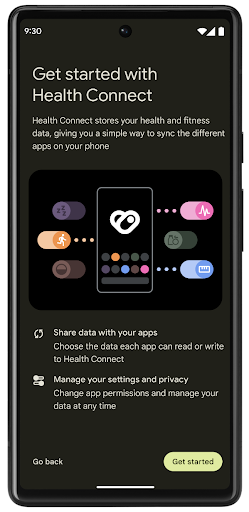
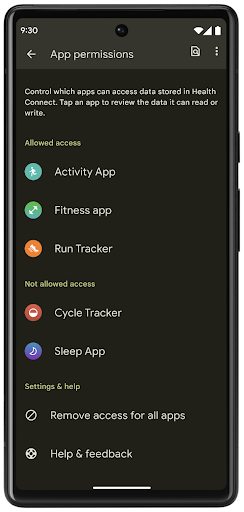
Health Connect includes several new features in Android 14, such as exercise routes, allowing users to share a route of their workout which can be visualized on a map. A route is defined as a list of locations saved within a window of time, and your app can insert routes into exercise sessions, tying them together. To ensure that users have complete control over this sensitive data, users must allow sharing individual routes with other apps.
For more information, see the Health Connection documentation and the blogpost on What's new in Android Health.
OpenJDK 17 の更新
Android 14 continues the work of refreshing Android's core libraries to align with the features in the latest OpenJDK LTS releases, including both library updates and Java 17 language support for app and platform developers.
The following features and improvements are included:
- Updated approximately 300
java.baseclasses to Java 17 support. - Text Blocks, which introduce multi-line string literals to the Java programming language.
- Pattern Matching for instanceof, which allows an object to
be treated as having a specific type in an
instanceofwithout any additional variables. - Sealed classes, which allow you restrict which classes and interfaces can extend or implement them.
Thanks to Google Play system updates (Project Mainline), over 600 million devices are enabled to receive the latest Android Runtime (ART) updates that include these changes. This is part of our commitment to give apps a more consistent, secure environment across devices, and to deliver new features and capabilities to users independent of platform releases.
Java and OpenJDK are trademarks or registered trademarks of Oracle and/or its affiliates.
アプリストアの改善
Android 14 では、アプリストアでのユーザー エクスペリエンスを改善するための PackageInstaller API がいくつか導入されています。
ダウンロードする前にインストールの承認をリクエストする
アプリをインストールまたは更新する際に、ユーザーの承認が必要になる場合があります。たとえば、REQUEST_INSTALL_PACKAGES 権限を使用するインストーラが新しいアプリをインストールしようとした場合などです。以前のバージョンの Android では、APK がインストール セッションに書き込まれ、セッションが commit された後にのみ、アプリストアはユーザーの承認をリクエストできました。
Android 14 以降では、requestUserPreapproval() メソッドを使用して、インストール セッションを commit する前に、ユーザーの承認をリクエストできます。この改善により、ユーザーがインストールを承認するまで、アプリストアで APK のダウンロードが延期されます。さらに、ユーザーがインストールを承認すると、アプリストアはユーザーの作業を妨げることなく、バックグラウンドでアプリをダウンロードしてインストールできます。
今後の更新に責任を持つことを示す
setRequestUpdateOwnership() メソッドを使用すると、インストーラはインストールしているアプリの今後の更新に責任を持つことをシステムに示すことができます。この機能により、更新の所有権の適用が有効になります。つまり、更新の所有者のみがアプリに自動更新をインストールできます。更新の所有権を適用することで、ユーザーは想定されるアプリストアからのみ更新を受け取ることができます。
その他のインストーラ(INSTALL_PACKAGES 権限を利用するものを含む)は、更新をインストールするために、ユーザーの明示的な承認を得る必要があります。ユーザーが別のソースから更新を進めた場合、更新の所有権は失われます。
影響が少ないタイミングでアプリを更新する
アプリストアは通常、アクティブに使用されているアプリを更新することはありません。これは、アプリの実行中のプロセスが強制終了され、ユーザーの操作が中断される可能性があるためです。
Android 14 以降では、InstallConstraints API を使用することで、インストーラはアプリの更新を適切なタイミングで行えます。たとえば、アプリストアで commitSessionAfterInstallConstraintsAreMet() メソッドを呼び出して、ユーザーがそのアプリを操作しなくなったときにのみ更新が commit されるようにできます。
オプションの分割をシームレスにインストールする
分割 APK を使用すると、アプリの機能をモノリシック APK としてではなく、別々の APK ファイルで配信できます。これにより、アプリストアでさまざまなアプリ コンポーネントの配信を最適化できます。たとえば、アプリストアは、ターゲット デバイスのプロパティに基づいて最適化できます。PackageInstaller API は、API レベル 22 で導入されて以来、分割をサポートしています。
Android 14 では、setDontKillApp() メソッドを使用して、新しい分割がインストールされたときに、アプリの実行中のプロセスを強制終了すべきでないことを示せます。アプリストアでは、この機能を使用して、ユーザーがアプリを使用しているときに、アプリの新しい機能をシームレスにインストールできます。
アプリのメタデータ バンドル
Starting in Android 14, the Android package installer lets you specify app metadata, such as data safety practices, to include on app store pages such as Google Play.
ユーザーがデバイスのスクリーンショットを撮影したときに検出する
Android 14 では、スクリーンショットの検出の標準化されたエクスペリエンスを実現するため、プライバシーを保護するスクリーンショット検出 API が導入されました。この API を使用すると、アプリはアクティビティごとにコールバックを登録できます。アクティビティが表示されている間にユーザーがスクリーンショットを撮ると、これらのコールバックが呼び出され、ユーザーに通知されます。
ユーザー エクスペリエンス
共有シートのカスタム アクションとランキングの改善
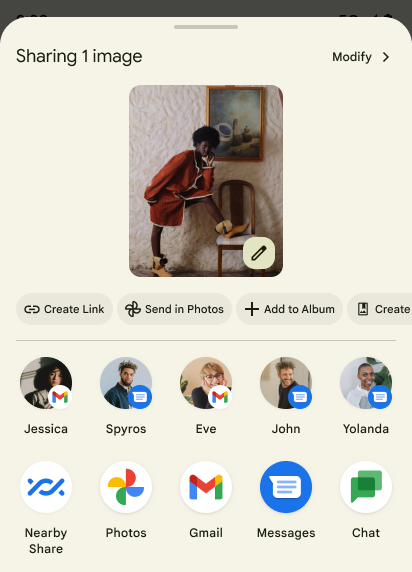
Android 14 updates the system sharesheet to support custom app actions and more informative preview results for users.
Add custom actions
With Android 14, your app can add custom actions to the system sharesheet it invokes.
Improve ranking of Direct Share targets
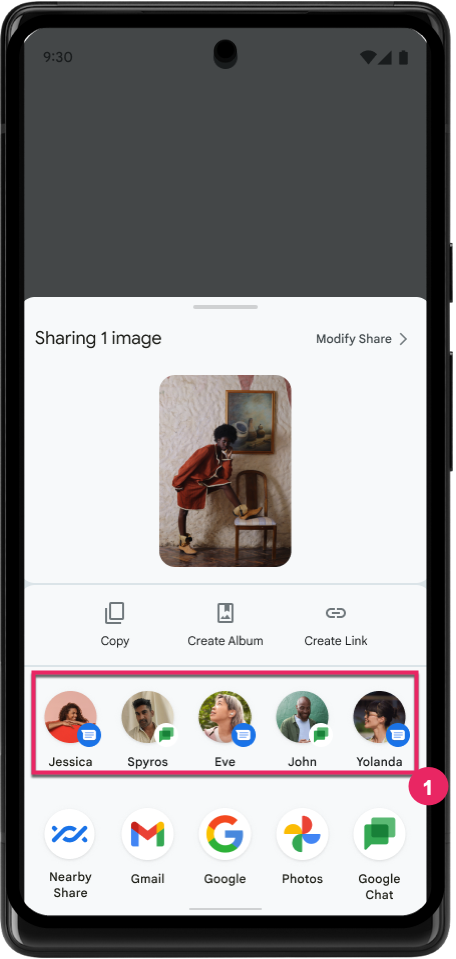
Android 14 uses more signals from apps to determine the ranking of the direct share targets to provide more helpful results for the user. To provide the most useful signal for ranking, follow the guidance for improving rankings of your Direct Share targets. Communication apps can also report shortcut usage for outgoing and incoming messages.
予測型「戻る」の組み込みアニメーションとカスタム アニメーションのサポート
Android 13 では、開発者向けオプションの背後に予測型「戻る」アニメーションが導入されました。開発者向けオプションが有効になっているサポート対象アプリで使用すると、後方にスワイプすると、戻るジェスチャーでアプリが終了してホーム画面に戻ることを示すアニメーションが表示されます。
Android 14 では、予測型「戻る」機能の改善が複数行われ、新しいガイダンスが追加されています。
android:enableOnBackInvokedCallback=trueを設定すると、アプリ全体ではなくアクティビティごとに、予測型「戻る」システム アニメーションを有効にできます。- Android 13 の「ホームに戻る」アニメーションに伴い、新しいシステム アニメーションが追加されました。新しいシステム アニメーションはアクティビティ間およびタスク間で動作し、予測型「戻る」に移行すると自動的に適用されます。
- ボトムシート、サイドシート、検索に新しいマテリアル コンポーネント アニメーションを追加しました。
- カスタムのアプリ内アニメーションと遷移を作成する際の設計ガイダンスを作成しました。
- カスタムのアプリ内遷移アニメーションをサポートする新しい API が追加されました。
handleOnBackStarted、handleOnBackProgressed、handleOnBackCancelledinOnBackPressedCallbackonBackStarted、onBackProgressed、onBackCancelledinOnBackAnimationCallback- ユーザーが後方にスワイプしたときに遷移を再生するには、
overridePendingTransitionではなくoverrideActivityTransitionを使用します。
この Android 14 プレビュー リリースでは、予測型「戻る」のすべての機能は開発者向けオプションに引き続き隠されています。アプリを予測型「戻る」に移行するデベロッパー ガイドと、カスタム アプリ内遷移を作成するデベロッパー ガイドをご覧ください。
大画面デバイスのメーカーによるアプリごとのオーバーライド
アプリごとのオーバーライドを使用すると、デバイスのメーカーは、大画面デバイスでアプリの動作を変更できます。たとえば、FORCE_RESIZE_APP オーバーライドは、アプリ マニフェストで resizeableActivity="false" が設定されている場合でも、ディスプレイ ディメンションに合わせてアプリのサイズを変更するよう(サイズ互換モードを回避するよう)システムに指示します。
オーバーライドは、大画面でのユーザー エクスペリエンスを向上させることを目的としています。
新しいマニフェスト プロパティを使用すると、アプリについてデバイス メーカーのオーバーライドの一部を無効にできます。
大画面ユーザーのアプリごとのオーバーライド
Per-app overrides change the behavior of apps on large screen devices. For example, the OVERRIDE_MIN_ASPECT_RATIO_LARGE device manufacturer override sets the app aspect ratio to 16:9 regardless of the app's configuration.
Android 14 QPR1 enables users to apply per‑app overrides by means of a new settings menu on large screen devices.
アプリの画面共有
App screen sharing enables users to share an app window instead of the entire device screen during screen content recording.
With app screen sharing, the status bar, navigation bar, notifications, and other system UI elements are excluded from the shared display. Only the content of the selected app is shared.
App screen sharing improves productivity and privacy by enabling users to run multiple apps but limit content sharing to a single app.
Google Pixel 8 Pro の Gboard で LLM を活用したスマート リプライを使用する
On Pixel 8 Pro devices with the December Feature Drop, developers can try out higher-quality smart replies in Gboard powered by on-device Large Language Models (LLMs) running on Google Tensor.
This feature is available as a limited preview for US English in WhatsApp, Line, and KakaoTalk. It requires using a Pixel 8 Pro device with Gboard as your keyboard.
To try it out, first enable the feature in Settings > Developer Options > AiCore Settings > Enable Aicore Persistent.
Next, open a conversation in a supported app to see LLM-powered Smart Reply in Gboard's suggestion strip in response to incoming messages.
グラフィック
パスのクエリと補間に対応
Android 的 Path API 是一种强大且灵活的机制,可用于创建和渲染矢量图形,能够描边或填充路径、根据线段或二次曲线或立方曲线构建路径、执行布尔运算以获取更复杂的形状,或同时执行所有这些操作。但有一个限制是,您无法了解 Path 对象中实际包含的内容;该对象的内部信息在创建后对调用方是不透明的。
如需创建 Path,您可以调用 moveTo()、lineTo() 和 cubicTo() 等方法来添加路径段。但是,无法询问该路径有哪些片段,因此您必须在创建时保留该信息。
从 Android 14 开始,您可以查询路径以了解其内部内容。首先,您需要使用 Path.getPathIterator API 获取 PathIterator 对象:
Kotlin
val path = Path().apply {
    moveTo(1.0f, 1.0f)
    lineTo(2.0f, 2.0f)
    close()
}
val pathIterator = path.pathIterator
Java
Path path = new Path();
path.moveTo(1.0F, 1.0F);
path.lineTo(2.0F, 2.0F);
path.close();
PathIterator pathIterator = path.getPathIterator();
接下来,您可以调用 PathIterator 逐个遍历片段,并检索每个片段的所有必要数据。以下示例使用了 PathIterator.Segment 对象,它会为您打包数据:
Kotlin
for (segment in pathIterator) {
    println("segment: ${segment.verb}, ${segment.points}")
}
Java
while (pathIterator.hasNext()) {
    PathIterator.Segment segment = pathIterator.next();
    Log.i(LOG_TAG, "segment: " + segment.getVerb() + ", " + segment.getPoints());
}
PathIterator 还有一个非分配版 next(),您可以在其中传入缓冲区来保存点数据。
查询 Path 数据的一个重要用例是插值。例如,您可能想在两个不同的路径之间添加动画(或变形)。为了进一步简化该用例,Android 14 针对 Path 还包含 interpolate() 方法。假设两个路径具有相同的内部结构,interpolate() 方法会使用该插值结果创建一个新的 Path。以下示例返回了一个形状介于 path 和 otherPath 之间的一半(线性插值为 0.5)的路径:
Kotlin
val interpolatedResult = Path()
if (path.isInterpolatable(otherPath)) {
    path.interpolate(otherPath, .5f, interpolatedResult)
}
Java
Path interpolatedResult = new Path();
if (path.isInterpolatable(otherPath)) {
    path.interpolate(otherPath, 0.5F, interpolatedResult);
}
Jetpack graphics-path 库也为早期版本的 Android 启用了类似的 API。
頂点シェーダーとフラグメント シェーダーを使用したカスタム メッシュ
Android 长期以来一直支持使用自定义着色绘制三角网格,但输入网格格式仅限于一些预定义的属性组合。Android 14 增加了对自定义网格的支持,可将其定义为三角形或三角形条,并且可以选择是否编入索引。这些网格是使用自定义属性、顶点步长、可变以及使用 AGSL 编写的顶点着色器和片段着色器指定的。
顶点着色器定义了位置和颜色等变量,而片段着色器可以选择为像素定义颜色,通常是使用顶点着色器创建的变量。如果片段着色器提供颜色,则系统会使用绘制网格时选择的混合模式将其与当前 Paint 颜色混合。Uniform 可以传递到片段着色器和顶点着色器,以提高灵活性。
Canvas のハードウェア バッファ レンダラ
To assist in using Android's Canvas API to draw with
hardware acceleration into a HardwareBuffer, Android 14
introduces HardwareBufferRenderer. This API is
particularly useful when your use case involves communication with the system
compositor through SurfaceControl for low-latency
drawing.